What is the difference between ERP and MES?
When manufacturers talk about digital transformation or Industry 4.0, two terms appear again and again: ERP and MES. Both are essential. Both are powerful. But they are not the same, and they both serve a unique purpose and require specialism.
Instead, the most successful textile, plastics, and packaging manufacturers integrate ERP and MES to create a fully connected, data-driven, high-performance production environment.
What is an ERP system?
ERP (Enterprise Resource Planning) is the “business brain” of the company. It manages everything that happens before and after production, including:
- sales orders and customers,
- planning and scheduling,
- purchasing, inventory and stock levels,
- finance, costing and invoicing,
- sometimes HR, maintenance, CRM and more.
According to NetSuite, ERP serves as the enterprise‑wide planning layer, coordinating finance, supply chain, inventory, HR, and order management across all departments. ERP gives management a global overview of the business but it rarely sees what is happening right now on the machines.
What is an MES?
MES (Manufacturing Execution System) is the “shop-floor brain” of the factory and the foundation of Industry 4.0. While ERP works at the enterprise level, MES connects directly to the production floor, giving supervisors and operators a live view of what is happening now in production.
Why you need both ERP and MES
You can think of ERP and MES as two complementary layers in the same organisation: ERP mainly keeps financial oversight, while MES executes the work.
Key differences:
- Scope: ERP covers the entire business; MES focuses narrowly on production efficiency, quality and cost.
- Data capture: MES captures factory-floor data in real time for immediate action; ERP captures enterprise-wide data for both short- and long-term analysis.
- Triggers: MES responds to manufacturing events; ERP responds to operational and accounting events.
- Integration: MES integrates with shop-floor machinery; ERP integrates with various business systems or includes built-in modules.
They overlap around orders and production quantities, but they serve different purposes. Some companies try to use ERP only and expect it to cover the shop floor. That usually leads to:
- manual data entry at the end of the shift or day,
- delays and errors in feedback from production,
- limited visibility into real problems on machines.
Others try to use MES only, which gives excellent shop-floor insight, but no link to planning, stock or costing. The most powerful setup is when ERP and MES work together:
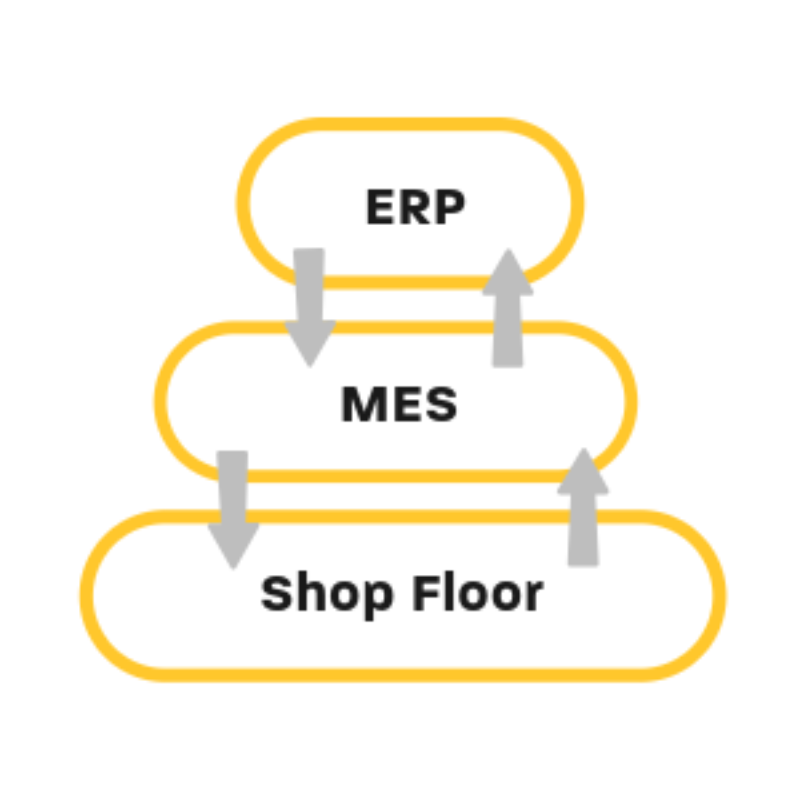
- ERP decides what must be produced and by when,
- MES makes sure it is produced efficiently, and reports back how it went.
Integration benefits
The World Economic Forum highlights that leading manufacturers achieve the highest digital maturity when ERP, MES, and IIoT systems work together as part of a unified smart‑factory architecture.
When MES and ERP are connected, production data flows seamlessly into business systems, aligning manufacturing with inventory, supply chain, sales, and customer service. This leads to better forecasting, efficient inventory control, improved cash flow, and higher customer satisfaction. Some advanced ERP systems include MES modules, eliminating the need for separate solutions.
In short, MES optimizes how products are made, while ERP optimizes how the entire business runs — and together, they provide a unified, data-driven operational view.
This combination creates a complete digital thread across the factory: from planning to execution to financial reporting. Modern MES systems are recognized globally as a critical enabler of smart factories and Industry 4.0. According to the Manufacturing Enterprise Solutions Association (MESA International), MES forms the central layer connecting ERP systems with real-time operations, supporting quality, compliance, and end-to-end traceability in regulated and high-precision industries.